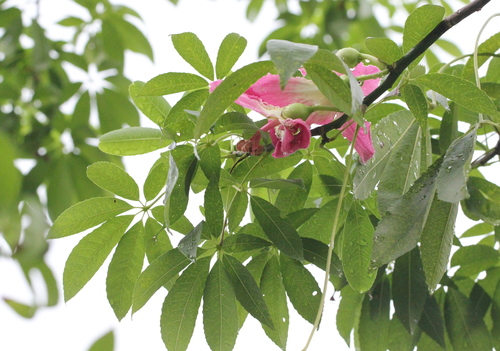
Deciduous tree that can exceed 25 m, with a bottle-shaped trunk swollen in its lower third. Trunk and branches carry stout conical prickles; bark green when young, grey with age. Leaves palmate with five to seven leaflets. Flowers 10–15 cm across, five petals, creamy-white at the centre and pink towards the tips. Woody ovoid capsules about 20 cm long hold black seeds in silky floss.
Notes
Added from the bed photo. Spiny green trunk, centre right
In the wild
Conservation status
Least ConcernWikidata · checked Nov 2026
Habitat summary
A tree of seasonally dry tropical regions, native to Argentina Northeast, Bolivia, Brazil North, Brazil Northeast, Brazil South.
Native range
Argentina Northeast, Bolivia, Brazil North, Brazil Northeast, Brazil South, Brazil Southeast, Brazil West-Central, Paraguay, Peru
Introduced to
Ethiopia, India
About this species
Ceiba speciosa, the floss silk tree, is a species of deciduous tree that is native to the tropical and subtropical forests of South America. It has several local common names, such as palo borracho, or árbol del puente, samu'ũ, or paineira. In Bolivia, it is called toborochi, meaning "tree of refuge" or "sheltering tree". In the USA it often is called the silk floss tree. It belongs to the same subfamily as the baobab; the species Bombax ceiba; and other kapok trees. Another tree of the same ge Read more on Wikipedia (opens in a new tab)